
Your wedding or bridal shoot ends. The photos are perfect. But your face still wears three layers of primer, full-coverage foundation, setting spray, heavy contouring, and waterproof eye makeup. Now comes the part most brides get wrong removing all of it without wrecking their skin.
Heavy makeup, especially the kind applied for Pakistani bridal events like barat, walima, and mehndi, involves products layered far beyond what a regular daily routine handles. Strip it off incorrectly and you risk micro-tears in the skin barrier, clogged pores, breakouts within 48 hours, redness, and dryness that lasts days. Remove it correctly and your skin bounces back overnight.
This guide gives you the exact method our team at Shagufta Bridal recommends to every bride after her event: a skin-first, step-by-step routine that dissolves every layer without friction, without harsh scrubbing, and without stripping your natural moisture barrier.
Why Heavy Makeup Removal Requires a Different Approach
Standard makeup, a tinted moisturiser, mascara, and lip gloss, dissolves easily with a simple cleanser. Bridal and stage-level makeup is a different category entirely. It combines long-wear silicone-based foundations, pigment-dense eyeshadows, waterproof mascara and liner, setting sprays with film-forming polymers, heavy concealers, and often prosthetic adhesive for false lashes.
Water alone removes none of it. A single-step cleanser removes some. But residue left behind, particularly from silicone-based products and waterproof formulas, sits inside pores, traps oil, and triggers breakouts. The skin also needs to breathe after hours under occlusive layers.
The solution is a sequenced two-step method called double cleansing, followed by hydration. Each step has a specific function. Skip one and the next day’s skin tells you immediately.
At Shagufta Bridal in Islamabad and Rawalpindi, our artists apply heavy bridal makeup designed to last 12–18 hours through ceremonies, photography, and outdoor heat. We build this skincare removal routine into every bride’s post-event guide because clean skin the morning after is as important as the flawless look during the event.
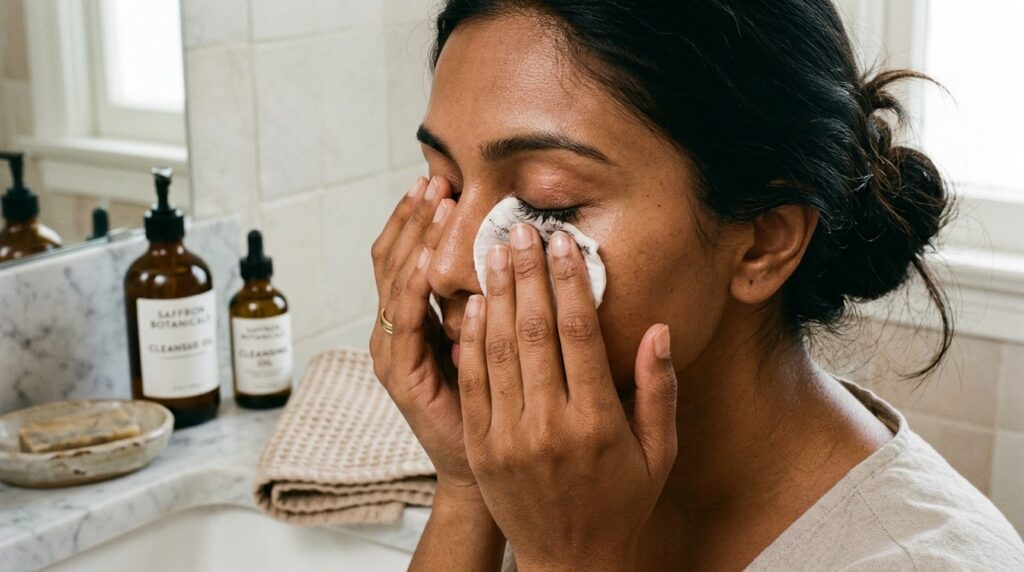
The Step-by-Step Method: How to Remove Heavy Makeup Safely
Follow these six steps in sequence. Do not skip steps or change the order , the sequence matters.
Remove False Lashes First
Soak a cotton round with an oil-based eye makeup remover and press it gently against the lash band for 15–20 seconds. The oil dissolves the lash adhesive. Slide the lash strip off from the outer corner inward , never pull upward. Pulling the glue bond without dissolving it first removes real lashes with the falsies. If the lash does not release easily, soak for 10 more seconds and try again.
Dissolve Eye and Lip Makeup with an Oil-Based Remover
The eye area carries the heaviest, most waterproof pigment: mascara, kohl, eyeshadow, and liner. These products are formulated to resist water. An oil-based remover is the only effective option , micellar water does not fully dissolve waterproof eye formulas. Soak a cotton pad, press it against the closed eye for ten full seconds, then wipe gently in one direction. Repeat on the opposite eye with a fresh pad. Apply the same method to lips: press, hold, wipe. No rubbing. The delicate skin around the eyes has no oil glands and thins significantly over time when pulled repeatedly.
Apply a Cleansing Balm or Oil to the Face and Neck
Scoop a generous amount of cleansing balm , about the size of a 10-rupee coin , and press it into dry skin with dry hands. Never wet the face before applying oil-based products: water creates a barrier between the oil and the makeup, reducing effectiveness. Massage in slow, outward circular motions for a full 60 seconds. Work across the forehead, cheeks, nose, chin, and neck. The balm emulsifies the foundation, setting spray, contour, and blush into a milky layer. Rinse thoroughly with lukewarm water until the water runs clear.
Double Cleanse with a Gentle Water-Based Cleanser
The oil cleanse dissolves oil-based makeup. The second cleanse removes the oil residue itself, any remaining water-soluble particles, sweat, and surface debris. Choose a sulfate-free foam or gel cleanser matched to your skin type. Apply to damp skin, lather gently for 30–45 seconds, and rinse with lukewarm water. Avoid hot water , it strips the lipid layer that keeps the skin barrier intact. Pat dry with a clean cotton towel. Do not rub.
Apply a Hydrating Toner or Essence
Cleansing , even gentle cleansing , disturbs the skin’s pH balance. A hydrating toner with niacinamide, hyaluronic acid, or rose water restores balance and preps the skin to absorb the moisturiser applied next. Press toner into the skin with clean hands rather than wiping it with a cotton pad, which absorbs the product before the skin does.
Seal with Moisturiser and Eye Cream
After 12–18 hours under heavy makeup, the skin’s moisture barrier needs rebuilding. Apply a ceramide-rich or hyaluronic acid moisturiser while the skin is still slightly damp from toner , this locks in moisture rather than sitting on the surface. Follow with a gentle eye cream around the orbital bone to address the dryness and mild puffiness that often appears after extended eye makeup wear.
Choosing the Right Products for Your Skin Type
The same six-step sequence applies across all skin types, but the products within each step change based on your skin’s needs.
Dry Skin
Use a cleansing balm rather than a liquid oil for the first step. Choose a cream-based second cleanser. Finish with a thick, occlusive moisturiser containing ceramides or shea butter. Avoid any cleanser with sulfates , dry skin loses moisture quickly even from a single wash.
Oily Skin
Use lightweight jojoba or sunflower oil for the first cleanse. Both are non-comedogenic and will not block pores. Choose a gel-based, sulfate-free foam cleanser as the second step. Finish with an oil-free gel moisturiser. Skipping the moisturiser step on oily skin causes the skin to overproduce oil as a compensatory response , the opposite of what you want.
Sensitive Skin
Avoid fragrance in every product used. Use a fragrance-free cleansing balm and a gentle micellar water or fragrance-free oil-based remover for the eyes. Choose a second cleanser with minimal ingredients. Look for centella asiatica or allantoin in the toner to calm any post-cleanse irritation.
Combination Skin
Apply a balm on the drier zones , cheeks and outer forehead , and micellar water on the oilier T-zone during the first cleanse step. Use a gel cleanser as the second step across the full face. Apply a lighter moisturiser on the T-zone and a slightly richer formula on the cheeks and jawline.
How to Remove Specific Heavy Makeup Products
Waterproof Mascara and Kohl
Waterproof mascara contains waxes and film-forming polymers that bond to the lash. Only oil-based removers break this bond. Press an oil-soaked cotton pad against the lashes , not the lid , for a full 15 seconds. Slide downward, not outward. Wiping sideways spreads pigment toward the inner corner and into the tear duct. Never pull or scrub mascara off while dry: this snaps lashes and pulls the sparse ones that grow near the outer corner.
Full-Coverage Foundation and Setting Spray
Silicone-based foundations , the dominant formula in bridal makeup because of their long wear , do not dissolve in water-based cleansers. A cleansing balm or oil breaks the silicone matrix. Massage for at least 60 seconds before rinsing. Setting sprays with alcohol and film-forming polymers sometimes leave invisible residue after rinsing. The second water-based cleanse removes this layer completely.
Heavy Contour, Bronzer, and Blush
Pigment-dense powder products , especially those pressed into pores by setting spray , need the oil cleanse to lift them out. Massage in circular outward motions rather than downward strokes to work with the skin’s lymphatic flow and avoid pushing pigment deeper. Pay particular attention to the nose crease, hairline, and jawline , areas where contour pigment collects but rinsing often misses.
Long-Wear Lip Colour and Liquid Lipstick
Liquid lipstick and long-wear lip stains bond to the top layer of lip skin. An oil-based remover on a cotton round held against closed lips for ten seconds loosens the bond. Avoid scrubbing the lips , the skin here is thin and has no oil glands. After removing lipstick, apply a small amount of lip balm before sleeping to prevent dryness and peeling the next morning.
The Most Common Mistakes That Damage Skin After Heavy Makeup
Using makeup wipes as the only removal method. Wipes smear makeup across the skin surface without dissolving it. They leave a residue of preservatives and fragrance, and the physical dragging motion damages the skin barrier over time, particularly around the eyes.
Using micellar water to remove full heavy makeup. Micellar water excels at light-to-moderate makeup. For waterproof eye products and silicone-based foundations, it does not fully dissolve the formulas. It works as a supporting product, not a standalone solution for heavy makeup.
Rubbing the eye area. The skin around the eye is the thinnest on the face. Repeated rubbing contributes to dark circles, loss of elasticity, and premature fine lines. Always press, hold, and wipe , never scrub.
Skipping moisturiser after removal. After removing a full face of heavy product, the skin barrier is disrupted. Skipping the moisturiser step leaves the skin vulnerable to transepidermal water loss overnight, resulting in visible dryness, tightness, and increased sensitivity the next day.
Using hot water to rinse. Hot water strips the sebum that keeps the skin barrier intact. Lukewarm water rinses products effectively without compromising moisture. After a long ceremony, the skin is already under stress , hot water adds to it.
Falling asleep with makeup on. Even partial makeup left overnight sits inside pores for 6–8 hours during the skin’s natural renewal cycle. This directly causes milia, cystic acne, and dullness that persists for days.

The Best Makeup Remover Products by Category
Not all makeup removers are interchangeable. Each formula type does a specific job. Matching the product to the task is what makes removal fast, thorough, and skin-safe.
Cleansing balm. The most effective first-step option for full-face heavy makeup. Emulsifies silicone and oil-based formulas. Best for dry and all skin types.
Jojoba or sunflower oil. A budget-friendly first-cleanse option. Both are non-comedogenic and dissolve waterproof makeup without clogging pores. Best for oily and acne-prone skin.
Bifacial or two-phase remover. Contains an oil phase and a water phase that dissolve different formula types when shaken together. Ideal for eyes and heavy waterproof products across all skin types.
Micellar water. Gentle and no-rinse. Best used as a supporting step alongside double cleansing, or for travel when a balm is unavailable. Suited to sensitive and combination skin.
Sulfate-free gel cleanser. The correct second-step cleanser for oily and combination skin. Removes oil residue without stripping the skin barrier.
Cream cleanser. The correct second-step cleanser for dry and sensitive skin. Removes residue while adding a light moisture layer.
What to Do the Day After Heavy Makeup
The morning after a bridal event, many brides wake up to mild puffiness, dry patches, or the beginning of small breakouts , not because of the makeup itself, but because of incomplete removal or a disrupted skin barrier. A calm, simple routine the next day prevents these from developing further.
Wash your face with cool water and a gentle cleanser only. Skip active ingredients , retinol, vitamin C, AHA, BHA , for 24–48 hours after heavy makeup wear. These ingredients exfoliate or stimulate cell turnover, which is too aggressive for a barrier that is already mildly compromised. Apply a thick moisturiser and use SPF before going outside. Drink adequate water throughout the day. Avoid touching the face.
If a small breakout appears within 24–48 hours, apply a spot treatment with 2% salicylic acid directly to the affected area only. Do not spread it across the full face. Give the skin three to five days to settle before returning to your regular active ingredient routine.
Post-bridal skin alert: If you develop widespread redness, raised patches, or itching after makeup removal, stop all new products immediately and apply only a fragrance-free moisturiser. This reaction usually comes from a specific ingredient , an adhesive remover, a setting spray, or a cleanser. Identify the product and discontinue it. Consult a dermatologist if the reaction does not calm within 48 hours.
Natural Alternatives for Emergency Makeup Removal
Occasionally , especially after outdoor events in Rawalpindi and Islamabad where access to a full kit is limited , a dedicated makeup remover is not available. These household alternatives remove most heavy makeup safely in an emergency.
Coconut oil. Apply to dry skin, massage for 60 seconds, wipe off with a clean cloth, then follow with a gentle water-based cleanser. Non-comedogenic for most people, but those with acne-prone skin should wash thoroughly afterward.
Jojoba oil. A closer structural match to the skin’s natural sebum than most oils. Use the same method as coconut oil. Leaves no greasy residue after cleansing.
Pure aloe vera gel. Effective for dissolving light to moderate makeup and soothing inflamed skin. Less effective on waterproof mascara and silicone-based foundations without an oil-based first step.
Rose water alone does not dissolve heavy makeup. Body lotion works in an emergency but is not ideal for regular use around the eyes. Toothpaste and baking soda are too abrasive and alkaline for facial skin , do not use these.
FAQ:
Can I use baby oil to remove heavy bridal makeup?
Yes. Baby oil dissolves oil-based makeup including foundation, contour, and eye makeup. Apply to dry skin, massage for 60 seconds, then rinse. Follow with a water-based cleanser to remove the oil residue. Avoid using baby oil if you have acne-prone skin as it can clog pores with extended use. It works well as an occasional emergency substitute, not as a regular method.
How do I remove heavy eye makeup without pulling out my eyelashes?
Use an oil-based eye makeup remover on a cotton pad. Press the pad against the closed eye for 15 seconds , do not wipe yet. The oil dissolves the mascara and liner bond during these seconds. Then wipe downward in one gentle stroke, never sideways or upward. This press-and-hold method protects lashes because it removes makeup through dissolution rather than friction.
Is double cleansing necessary after heavy makeup, or is one wash enough?
One wash is not enough after full bridal or stage-level makeup. The first oil-based cleanse dissolves makeup. The second water-based cleanse removes the oil and any remaining particles. Skipping the second step leaves oil residue, setting spray film, and makeup traces that sit in pores overnight. Double cleansing is standard practice for any makeup heavier than everyday coverage.
What removes waterproof mascara without irritating sensitive eyes?
A fragrance-free, ophthalmologist-tested bifacial (two-phase) remover or a fragrance-free oil-based remover removes waterproof mascara without irritation. Apply to a cotton pad, press against the lash line for 10–15 seconds, and wipe downward. Avoid any product with alcohol, fragrance, or menthol near the eyes if your eyes are reactive or dry.
How do I remove makeup without a makeup remover at home?
Coconut oil or jojoba oil applied to dry skin and massaged for 60 seconds, followed by a thorough rinse and a gentle cleanser, removes most heavy makeup effectively. Always follow oil removal with a water-based cleanser to clear residue. Never use soap bars on the face , their high pH disrupts the skin barrier.
How long does it take to fully remove heavy bridal makeup?
Allow 10–15 minutes for a thorough removal routine after heavy bridal or event makeup. Eye and lash removal alone takes 3–5 minutes when done correctly with the press-and-hold technique. The first oil cleanse takes 2–3 minutes including massage and rinse. The second water-based cleanse takes 1–2 minutes. Toner and moisturiser take under 2 minutes. Rushing through the process leaves significant product residue behind.
Why do I break out after wearing heavy makeup, even when I remove it at night?
Breakouts after heavy makeup usually come from one of four causes: incomplete removal leaving silicone or pigment inside pores; an ingredient in the makeup or removal product that your skin reacts to; comedogenic products on acne-prone skin; or physical friction from rubbing during removal. Double cleansing thoroughly and avoiding harsh wiping resolves most post-makeup breakouts. If breakouts persist after consistent correct removal, review the makeup products used for comedogenic ingredients.
Can I use micellar water alone to remove heavy full-coverage foundation?
Micellar water removes light to moderate makeup effectively. For full bridal-coverage foundation , particularly silicone-based and long-wear formulas , micellar water does not fully dissolve the product. Saturating multiple cotton pads and wiping repeatedly also drags the skin surface unnecessarily. Use micellar water as a supporting product, not as a standalone method for heavy full-face coverage.
The Right Removal Routine Protects Your Investment in Your Skin
Heavy makeup removal is not a single product or a single wipe. It is a six-step routine that works in sequence: remove false lashes, dissolve eye and lip makeup with an oil-based remover, oil-cleanse the full face, water-cleanse to finish, restore pH with toner, and seal moisture with a ceramide-rich moisturiser.
The entire process takes 10–15 minutes. Those minutes protect the skin barrier, prevent breakouts, and ensure your skin looks healthy the morning after every bridal event , not irritated and congested.
At Shagufta Bridal in Islamabad and Rawalpindi, we apply makeup designed to last. We also believe the skin beneath it deserves care that lasts too.
If your next event is approaching, start with the fundamentals: oil cleanse, water cleanse, moisturise. Build the habit before the ceremony, and your skin will be your strongest asset , on the day and the morning after.